
What RCRA is and how it applies to electronics
RCRA is the framework governing the management of hazardous waste from generation to disposal, which the EPA describes in its RCRA overview. Electronics enter the picture because some components can qualify as hazardous waste, most commonly due to heavy metals such as lead and cadmium. When discarded electronics or their components meet the criteria for hazardous waste, RCRA management standards can apply to how they are stored, transported, and disposed of.
The reach of RCRA to a given device depends on the device, the components, and often the quantity and the entity discarding it, which is why organizations disposing of electronics at scale treat it as a compliance question rather than an afterthought.
Hazardous components in electronics
The environmental concern behind the rules is concrete. Older monitors and some components can contain lead; batteries and certain components can contain cadmium and other heavy metals; and various substances used in electronics are regulated because of their toxicity if released into the environment. These materials are the reason electronics are pulled out of the general trash, a growing US e-waste stream, and directed to specialized handling and the EPA’s work on the sustainable management of electronics.
None of these concerns has anything to do with the data on a storage device. A drive can be environmentally benign and still be a severe data-security liability, and a component can be a regulated environmental hazard while holding no data at all.
Federal rules, state rules, and where they differ
Electronics disposal in the United States is governed by a mix of federal and state law. RCRA sets the federal hazardous-waste baseline, but many states have enacted their own electronics recycling and disposal laws that go further, sometimes banning electronics from landfills or requiring manufacturer take-back programs. The practical consequence is that the specific requirements for disposing of a given device can depend on the state as much as on federal law.
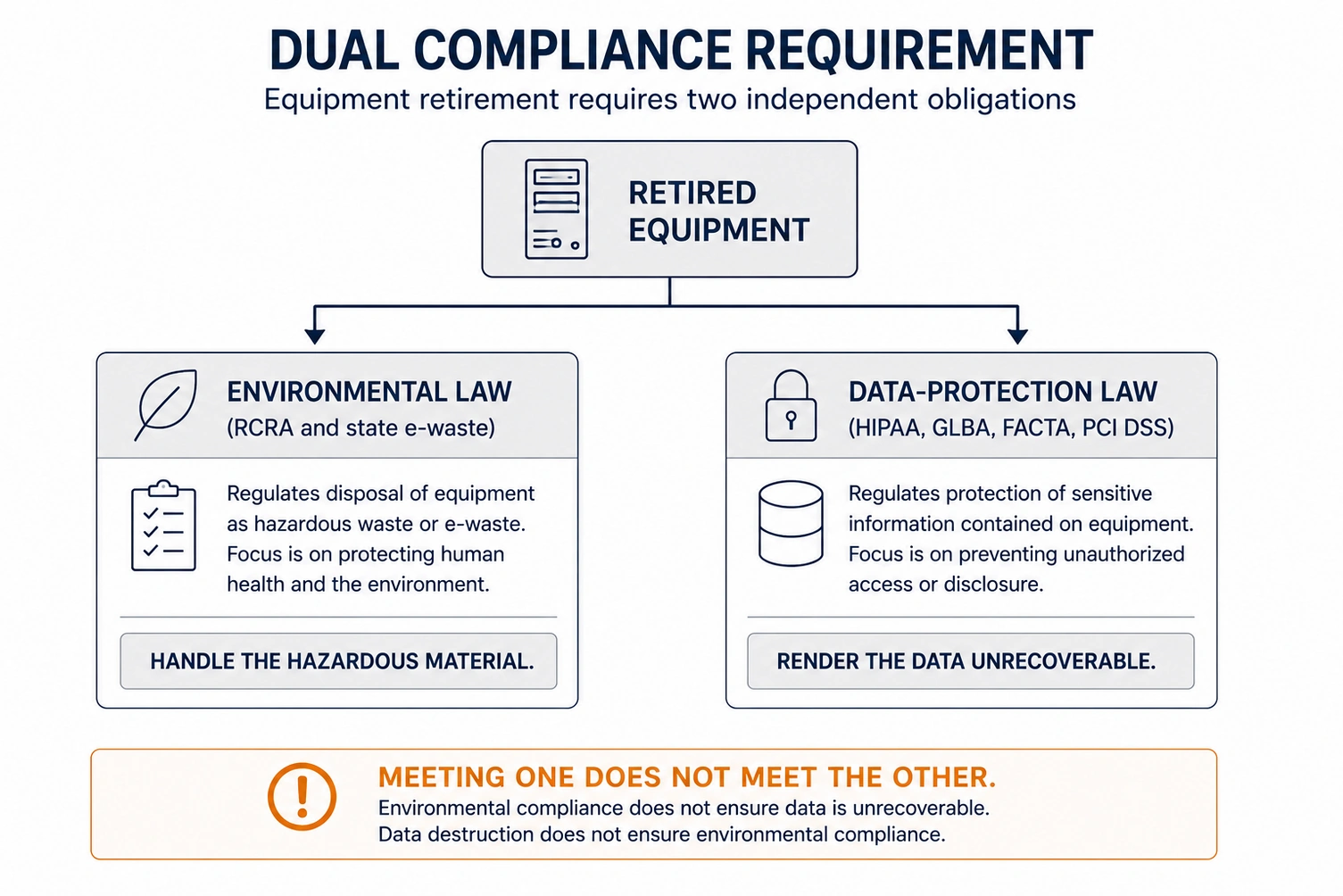
The judgment point for anyone retiring equipment is that this entire body of law addresses the material, not the information. A program can be fully compliant with federal and state e-waste rules and still commit a data-disposal violation, because the environmental rules never required the data to be destroyed.
Where data destruction and disposal law intersect
The two obligations meet at the same box of retired equipment but stay legally distinct. Environmental law, RCRA and state e-waste rules, requires the hazardous material to be handled and disposed of responsibly. Data-protection rules, such as HIPAA, the GLBA Safeguards Rule, the FACTA Disposal Rule, and PCI DSS, require the data to be rendered unrecoverable to the standard of the federal Guidelines for Media Sanitization. Meeting one does not meet the other. A defensible disposal process satisfies both in the right order: destroy the data first, under documented chain of custody, then hand the material to the hard drive recycling process or other environmentally compliant disposal. This content is informational and not legal advice; confirm your specific obligations with counsel.
Key points
- RCRA is the federal hazardous-waste law, administered by the EPA, that reaches electronics with hazardous components.
- RCRA governs the physical and environmental hazard, not the data on a device.
- State e-waste laws often go beyond RCRA, so requirements can depend on the state.
- Environmental compliance and data-disposal compliance are separate obligations; meeting one does not meet the other.
Data Destruction Inc. covers the data-disposal obligation that environmental law leaves untouched: we destroy the data on retired media by a method matched to the device, from hard drive shredding to secure hard drive disposal, under chain of custody handled by trained, bonded, background-checked operators, and issue a serialized Certificate of Destruction, provided within 24 hours after the destruction event is complete, so the material can then move to environmentally compliant recycling. To close the data side of an electronics disposal program, call (866) 850-7977.
FAQ
What is RCRA?
The Resource Conservation and Recovery Act is the federal law, administered by the EPA, that governs how hazardous waste is managed from generation through disposal. It reaches electronics whose components qualify as hazardous waste.
Does RCRA require me to destroy data on old devices?
No. RCRA governs the physical and environmental hazard of the equipment, such as heavy metals, not the data on a storage device. Data destruction is required by separate data-protection rules, not by RCRA.
Why are some electronics treated as hazardous waste?
Because components can contain regulated substances such as lead and cadmium that are harmful if released into the environment. That environmental concern, not any data concern, is what triggers hazardous-waste handling.
Do state laws add requirements beyond RCRA?
Often, yes. Many states have their own electronics recycling and disposal laws that go further than the federal baseline, sometimes banning electronics from landfills or mandating take-back programs, so requirements can depend on the state.
If I follow e-waste laws, is my data protected?
No. A program can fully comply with federal and state e-waste rules and still commit a data-disposal violation, because environmental law never required the data to be destroyed. Data protection is a separate obligation.
How do I satisfy both environmental and data-disposal rules?
Meet them in order: destroy the data first under documented chain of custody, then hand the material to environmentally compliant recycling or disposal. That sequence satisfies data-protection rules and RCRA and state e-waste law.
—