
What a self-encrypting drive is
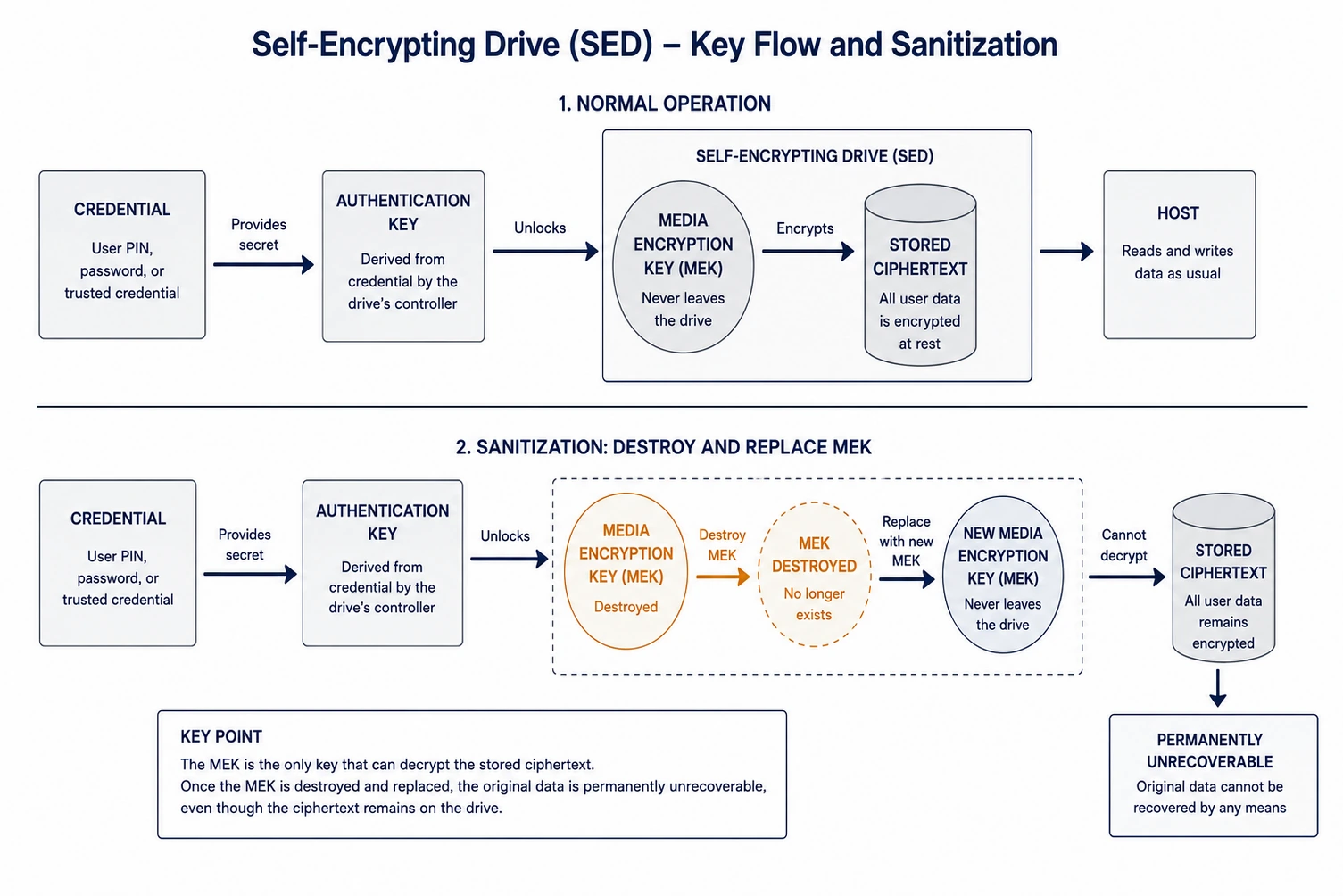
A self-encrypting drive contains a hardware encryption engine, typically AES, that encrypts data on the way in and decrypts it on the way out with no host involvement and no performance penalty. Two keys are central. The media encryption key (MEK), sometimes called the data encryption key, actually encrypts the stored data and never leaves the drive. An authentication key or key encryption key, derived from a user or administrator credential, unlocks the drive so the MEK can be used. Because the drive encrypts from the moment it is manufactured, there is never a period when plaintext is written to the platters or flash.
Most enterprise SEDs follow the TCG Opal specification for client drives or the Enterprise SSC for data-center drives, and some carry FIPS 140 validation of the cryptographic module.
How instant secure erase works
Instant secure erase, the SED form of cryptographic erase that NIST recognizes as a Purge, destroys and replaces the media encryption key. Once the MEK is gone, the ciphertext on the drive can never be decrypted, so all data becomes unrecoverable in a single fast operation regardless of drive capacity. Nothing has to be overwritten. This is why SED crypto-erase is attractive at scale and why it is generally stronger than software cryptographic erase: because the drive was always encrypted from manufacture, there is no pre-encryption plaintext to worry about, the flaw that undermines encryption turned on after the fact.
Why the assurance depends on trusting the drive
The method is only as good as the drive’s implementation, and that is the judgment an SED demands. You are trusting that the drive genuinely encrypted all data, that the MEK was strong and truly destroyed rather than retained, and that the firmware has no bypass. FIPS 140 validation of the module raises that confidence meaningfully, because the implementation has been independently tested. An unvalidated or unknown implementation lowers it. There is also a recovery mechanism to understand: the PSID printed on the drive label lets an administrator perform a factory revert that also cryptographically erases the drive, which is how you sanitize an SED whose password is lost.
When to crypto-erase and when to destroy
For most enterprise data on a validated SED that is being redeployed or resold, a verified instant secure erase is a legitimate NIST Purge and the efficient choice. For the highest-sensitivity or classified data common in government and defense contractor environments under FISMA and CMMC media sanitization, for drives whose SED implementation you cannot verify, and for regulated data leaving custody where you need unambiguous evidence, physical hard drive shredding remains the higher-assurance option under the federal Guidelines for Media Sanitization, and it can be paired with an SSD secure erase or overwrite-based wiping for defense in depth. The decision rule mirrors the rest of this cluster: trust plus verification enables Purge, while doubt or maximum sensitivity points to Destroy. This is general guidance, not legal advice; confirm your obligations with counsel.
Key points
- An SED encrypts all data in hardware from manufacture, with a media encryption key that never leaves the drive.
- Instant secure erase destroys that key, making the data unrecoverable in seconds.
- SED crypto-erase is generally stronger than software crypto-erase because there is no pre-encryption plaintext.
- The assurance depends on trusting the implementation, which FIPS 140 validation strengthens.
- The PSID revert sanitizes an SED whose password is lost; highest-sensitivity data still warrants destruction.
Data Destruction Inc. sanitizes self-encrypting drives by verifying the implementation and performing an instant secure erase where that is defensible, and by physically destroying the drive where the data sensitivity or an unverifiable implementation calls for it. Either path is handled under tamper-evident chain of custody by trained, bonded, background-checked operators, with a serialized Certificate of Destruction provided within 24 hours after the destruction event is complete. To sanitize an SED fleet, call (866) 850-7977.
FAQ
What is instant secure erase on an SED?
It is the SED form of cryptographic erase. The drive destroys and replaces its internal media encryption key, so the ciphertext can never be decrypted and all data becomes unrecoverable in seconds, without overwriting anything.
Is SED cryptographic erase NIST compliant?
Yes, it qualifies as a NIST Purge when the drive genuinely encrypted all data from manufacture, the key is truly destroyed, and the implementation is trustworthy. FIPS 140 validation of the module strengthens that assurance.
What if I lose the SED password?
Use the PSID, a value printed on the drive label, to perform a factory revert. The revert cryptographically erases the drive, which sanitizes it even when the password is unknown.
Are all SSDs self-encrypting?
No. Many SSDs are not SEDs, and some that have the hardware are not configured to enforce it. Confirm the drive is a self-encrypting model and that encryption was active before relying on instant secure erase.
When should a self-encrypting drive still be physically destroyed?
For the highest-sensitivity or classified data, when the SED implementation cannot be verified, and for regulated data leaving custody where you need unambiguous audit evidence. Destruction can also be combined with crypto-erase for defense in depth.
—