
What R2 and e-Stewards are
Both are voluntary standards that an electronics recycler can adopt and be audited against by an independent certification body.
- R2, short for Responsible Recycling, is managed by SERI (Sustainable Electronics Recycling International). It covers responsible reuse and recycling, environmental and worker health and safety, downstream accountability, and a data security requirement, and it is the more widely held of the two.
- e-Stewards is managed by the Basel Action Network (BAN). It shares the responsible-recycling goals but is stricter on the movement and disposal of toxic material, aligning with the Basel Convention on hazardous waste, and it also includes a data security requirement.
Both are recycler certifications. They describe how a recycler operates, not what happens to any one customer’s data.
How they compare
The practical differences cluster in a few dimensions that a comparison table makes clear.
| Dimension | R2 (Responsible Recycling) | e-Stewards |
|---|---|---|
| Managed by | SERI (Sustainable Electronics Recycling International) | Basel Action Network (BAN) |
| Primary emphasis | Responsible reuse and recycling, health, safety, downstream accountability | Responsible recycling with strict limits on toxic export and disposal |
| Export of hazardous e-waste | Permitted under controlled, documented conditions | Prohibited to developing (non-OECD) countries |
| Landfill or incineration of focus materials | Restricted | Prohibited |
| Use of prison labor | Not specifically prohibited | Prohibited |
| Data security provision | Requires a data sanitization process | Requires a data sanitization process |
| Relative adoption | Broader, more facilities hold it | Narrower, fewer facilities hold it |
| Independent third-party audit | Yes | Yes |
Where they overlap and where they differ
The overlap is substantial. Both require responsible downstream management, worker and environmental protections, tracking of material through the recycling chain, and a documented data sanitization process, and both are verified by independent audit rather than self-declared.
The differences are mostly ethical and environmental rather than technical. e-Stewards takes a harder line on exporting hazardous material to developing countries, on landfill and incineration, and on prison labor, which makes it the stricter standard on toxics and global environmental justice. R2 is more widely adopted and permits some controlled practices that e-Stewards prohibits, which is part of why more facilities hold it. If your priority is minimizing the environmental and ethical footprint of recycling, that is the axis the choice turns on.
The critical limit: neither certifies your data was destroyed
Here is the judgment point that reframes the whole comparison. Both standards require the recycler to have a data sanitization process, but that is a statement about the recycler’s general operations, not a guarantee applied to your specific media. A certification hanging on the wall does not tell you that the particular drives you sent were sanitized to the standard your data required, nor does it hand you evidence you can show an auditor for those assets. The data assurance you actually need is item-level: a documented chain of custody and a serialized Certificate of Destruction for your media, not a recycler’s facility certification.
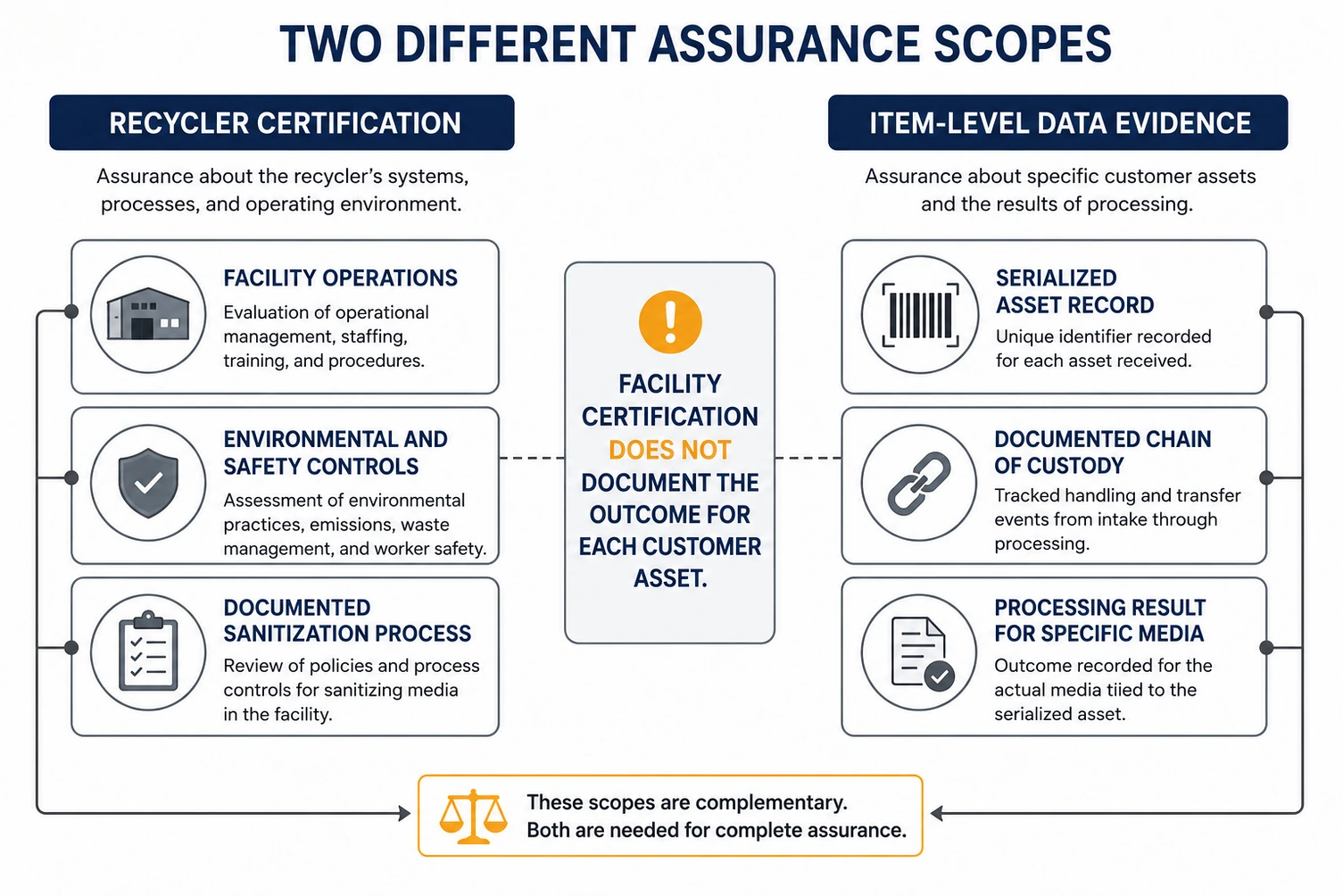
The second judgment point follows: relying on a recycler’s R2 or e-Stewards status as your data-security control inverts the risk. Recycler certifications are designed around material and environmental responsibility, with data sanitization as one component among many, whereas your obligation under rules like HIPAA and the GLBA Safeguards Rule is specifically that your data was rendered unrecoverable. Those are not the same assurance, and one does not stand in for the other.
Choosing between them, and the decision that matters more
So the choice between R2 and e-Stewards is a real decision, but it is an environmental and ethical one: pick e-Stewards if you want the strictest limits on toxic export and disposal, or R2 if broader availability and its framework fit your program better. Either way, that choice does not resolve data security. The decision that matters more for data is upstream of the recycler entirely: destroy the data first, under documented chain of custody, and obtain a Certificate of Destruction for the specific media, then send the material to whichever certified recycler matches your environmental priorities. Get that order right and the recycler certification becomes what it should be, an environmental credential, not a data-security crutch. This content is informational and not legal advice; confirm your obligations with counsel.
Key points
- R2 (managed by SERI) and e-Stewards (managed by BAN) are the two leading electronics recycler certifications, both independently audited.
- Their main differences are environmental and ethical: export, toxics, landfill, and labor, with e-Stewards the stricter and R2 the more widely adopted.
- Both require a data sanitization process, but that certifies the recycler’s operations, not the destruction of your specific data.
- The data decision that matters most is upstream: destroy the data first with a Certificate of Destruction, then choose a recycler on environmental grounds.
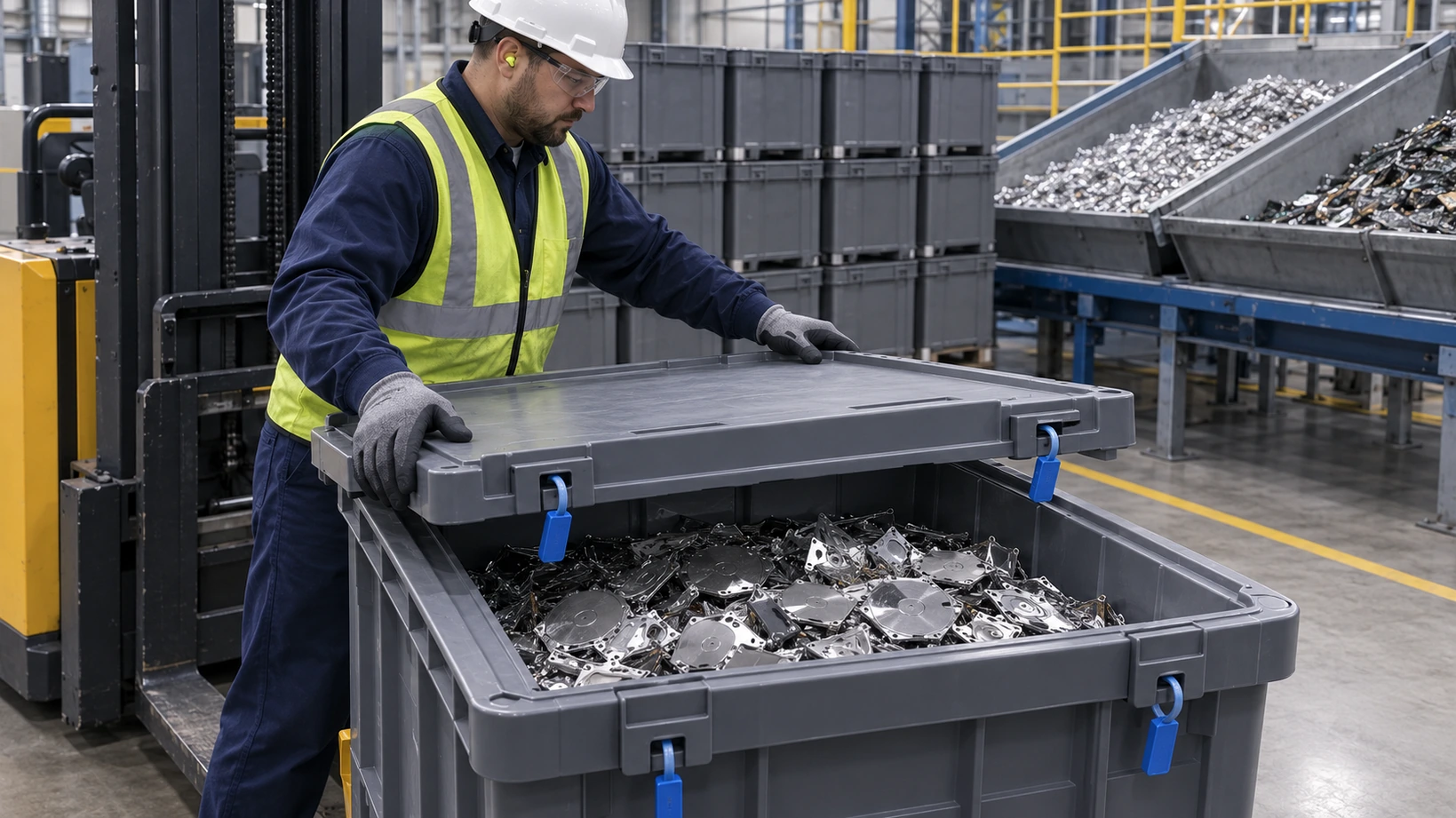
Data Destruction Inc. provides the item-level data assurance a recycler certification does not: we destroy the data on your specific media under tamper-evident chain of custody handled by trained, bonded, background-checked operators, and issue a serialized Certificate of Destruction, provided within 24 hours after the destruction event is complete, so you can send the material to any R2 or e-Stewards recycler with the data risk already resolved. To put destruction ahead of recycling in your program, call (866) 850-7977.
Related reading: hard drive recycling process and EPA, RCRA, and electronics disposal. Related services: hard drive shredding and certificate of destruction. Compliance context is in our HIPAA media disposal and GLBA Safeguards Rule guides.
Authoritative standards: NIST SP 800-88 Rev. 2, Guidelines for Media Sanitization, and the US EPA on the sustainable management of electronics.
FAQ
What is the difference between R2 and e-Stewards?
Both are audited electronics recycler certifications, but e-Stewards is stricter on exporting toxic material to developing countries, on landfill and incineration, and on prison labor, while R2 is more widely adopted and permits some controlled practices e-Stewards prohibits. The differences are mainly environmental and ethical.
Which certification is better for the environment?
e-Stewards takes the harder line on toxic export and disposal, so it is generally the stricter standard on environmental and ethical grounds. R2 is broader in adoption. The better choice depends on whether strictest toxics limits or wider availability matters more to your program.
Does an R2 or e-Stewards recycler destroy my data?
Both standards require the recycler to have a data sanitization process, but that certifies the recycler’s general operations, not the destruction of your specific drives. It is not, on its own, evidence that your data was rendered unrecoverable.
Can I rely on a recycler’s certification for data compliance?
No. Rules like HIPAA and the GLBA Safeguards Rule require that your data was rendered unrecoverable, which is an item-level assurance. A facility certification does not provide a Certificate of Destruction for your specific media, so it does not satisfy that obligation.
What should I do before sending media to any recycler?
Destroy the data first, under documented chain of custody, and obtain a serialized Certificate of Destruction for the specific media. Then send the material to whichever certified recycler fits your environmental priorities.
If I destroy data first, does the recycler’s certification still matter?
Yes, but only for its intended purpose. Once the data is destroyed and documented, the R2 or e-Stewards credential tells you the recycler handles the material responsibly, which is exactly what a recycling certification should signal.
—