Learn Guide
On-Site vs. Off-Site Data Destruction
On-site data destruction is preferable when unsanitized media must remain at the client location, direct observation is required, or transport exposure is…
Read guide
Learn Resource Center
Expert guides for secure data destruction, compliance requirements, and vendor selection best practices.
Learn Guide
On-site data destruction is preferable when unsanitized media must remain at the client location, direct observation is required, or transport exposure is…
Read guideLearn Guide
SSD shredding must destroy the NAND flash components that hold data, not merely bend the circuit board or break the enclosure. A…
Read guideLearn Guide
LTO tape can be sanitized through an approved logical or physical technique when the exact tape generation, recording format, encryption state, media…
Read guideLearn Guide
Yes. Data can often be recovered from old backup tapes when the magnetic recording remains readable and the organization can assemble compatible…
Read guideLearn Guide
TRIM is an operating-system notification that tells an SSD which logical blocks no longer contain needed data. Secure Erase is a device-level…
Read guideLearn Guide
Hard drive shredding, degaussing, and crushing address different parts of an enterprise media-sanitization decision. Shredding cuts a hard disk drive into particles.…
Read guideLearn Guide
Data recovery from a properly shredded hard drive becomes infeasible when the destruction process addresses the data-bearing platters, meets the approved output…
Read guideLearn Guide
Particle size affects how much data-bearing material remains intact after shredding or disintegration, but no single fragment size is correct for every…
Read guideLearn Guide
Hard drive shredding feeds a magnetic hard disk drive into purpose-built cutters that tear and deform the enclosure, platters, motor, heads, and…
Read guideLearn Guide
NAND flash stores information as electrical states in memory cells. Data remanence occurs when prior data remains in physical flash locations after…
Read guideLearn Guide
Deleting a file usually removes or changes the file-system reference that tells the operating system where the content belongs. The underlying sectors…
Read guide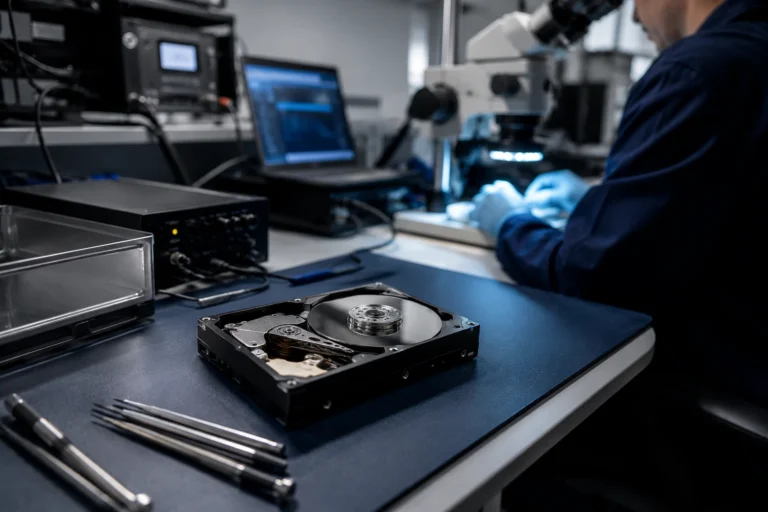
Learn Guide
Usually, yes. A hard drive that will not power on, clicks, or is not detected is most often broken in its electronics…
Read guide