
What media sanitization covers
Media sanitization is the full set of methods that make data unrecoverable to a defined level of assurance. NIST 800-88 r2 defines three:
- Clear, a logical overwrite that defeats non-invasive recovery and keeps the media reusable.
- Purge, a method that defeats laboratory recovery, including degaussing magnetic media, firmware secure-erase, and cryptographic erase.
- Destroy, physical destruction that ends the media’s usefulness.
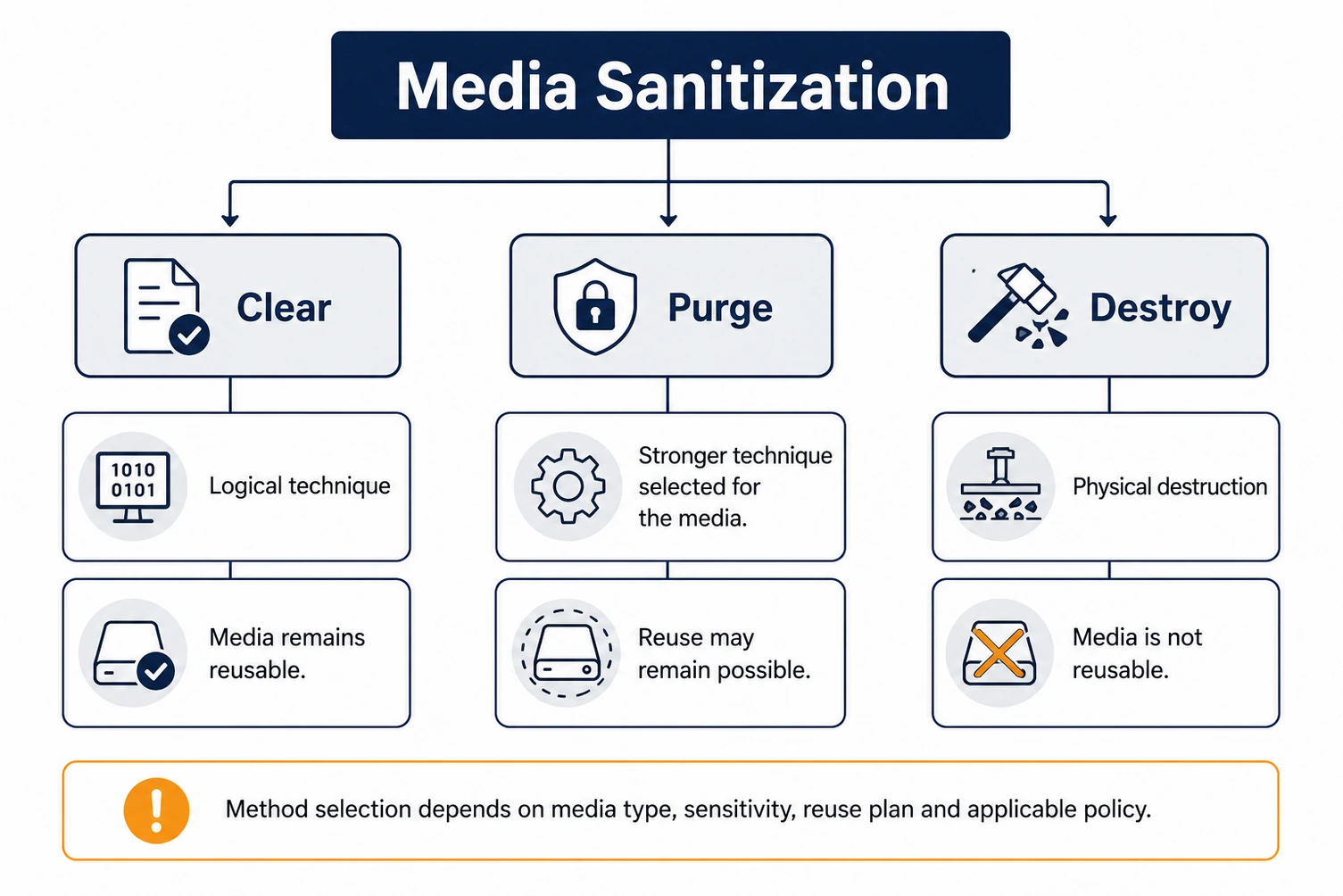
All three are sanitization. The difference between them is the assurance level and whether the media survives, not whether one counts as real sanitization and the others do not.
Where destruction fits inside sanitization
Physical destruction is the highest-assurance category because it removes the media itself from the equation. There is no controller, firmware, or overwrite coverage to trust; the platters or NAND no longer exist in readable form. That is why destruction is the default for the most sensitive data and for media that cannot be reliably sanitized in place, such as most consumer flash without a trusted firmware sanitize, optical discs, and any drive that will not power on to accept a command.
The trade-off is that destruction forecloses reuse and its residual value. A three-year-old fleet of healthy enterprise SSDs may be worth redeploying after a Purge; a batch of failed or highly sensitive drives is worth destroying outright.
Choosing: reuse value against risk
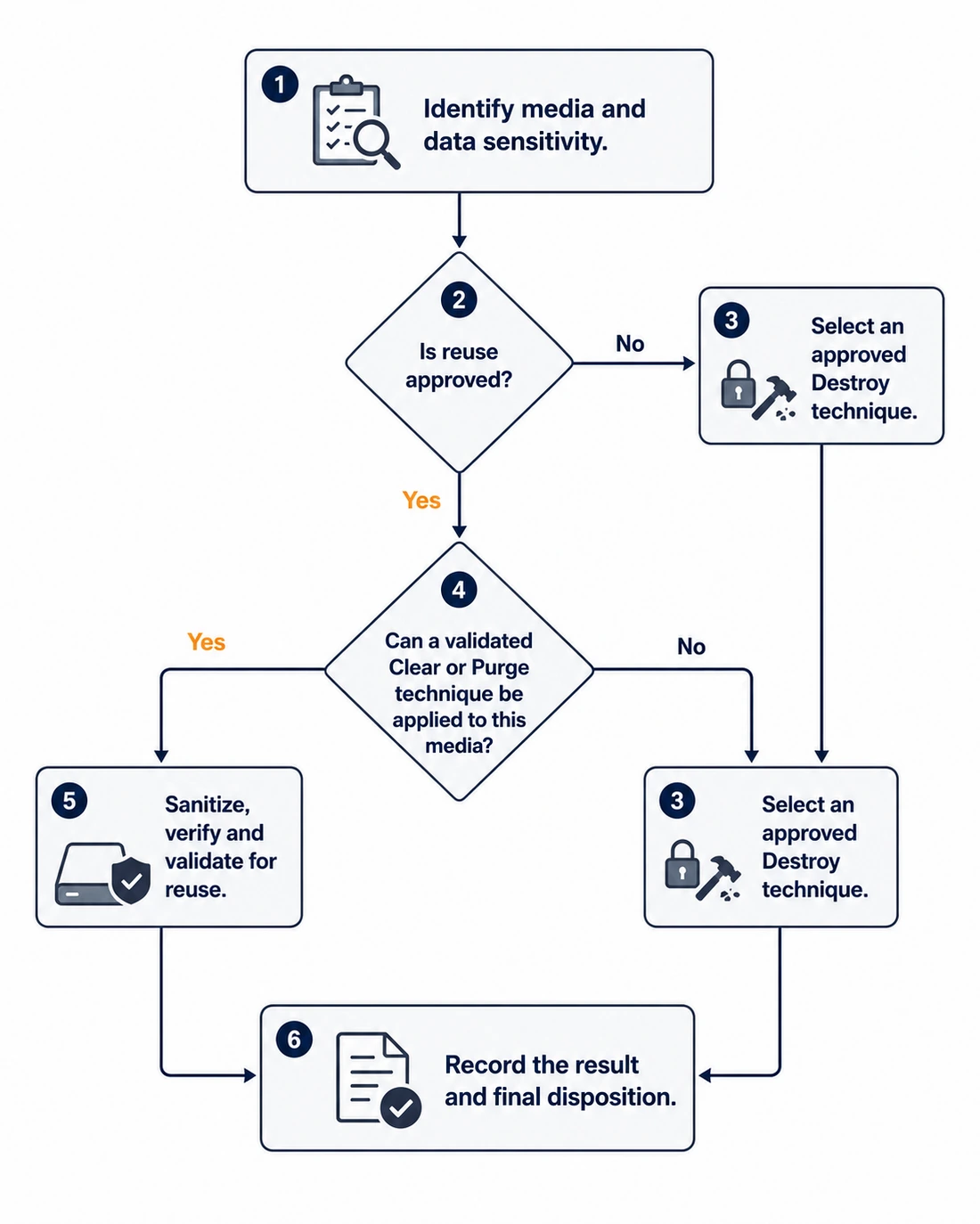
The decision is a balance of two variables, the residual value of reuse and the risk if sanitization is imperfect.
| Situation | Sanitize for reuse (Clear/Purge) | Destroy |
|---|---|---|
| Healthy magnetic drives, moderate sensitivity, reuse planned | Overwrite (Clear) | Optional |
| Self-encrypting SSDs, encrypted from first write, reuse planned | Cryptographic erase (Purge) | Optional |
| Highly sensitive or classified data | Not sufficient alone | Required |
| Media that will not accept a sanitize command | Not possible | Required |
| Optical discs | Not applicable | Required |
| Failed or end-of-life drives with no reuse value | Wasted effort | Preferred |
Compliance treats verified outcomes as equivalent
Regulators generally care that data was rendered unrecoverable and that you can prove it, not which of the three methods you used. A verified Purge and a documented Destroy both satisfy the outcome the rule demands, provided the method suited the media and the result is recorded. The proof, not the method, is where organizations most often fall short. This content is informational and not legal advice; confirm your obligations with counsel.
Key points
- Sanitization is the umbrella (Clear, Purge, Destroy); destruction is the Destroy category within it.
- Clear and Purge preserve reuse value; Destroy maximizes assurance and forecloses reuse.
- Destroy is required for highly sensitive data, unsanitizable media, and optical discs.
- Compliance accepts any verified method suited to the media, so documentation is decisive.
Data Destruction Inc. helps you decide per asset class: we Purge healthy encrypted drives you intend to redeploy and Destroy media that is too sensitive, unsanitizable, or at end of life, documenting either outcome with a serialized Certificate of Destruction, provided within 24 hours after the destruction event is complete. To build a reuse-versus-destroy policy for a fleet, call (866) 850-7977.
Related services: hard drive data wiping for reuse and hard drive shredding for destruction. Related reading: what is data destruction and wipe vs erase vs delete vs destroy. The three methods are defined in our NIST SP 800-88 overview, and financial services often mixes reuse and destruction across a fleet.
Authoritative standards: NIST SP 800-88 Rev. 2, Guidelines for Media Sanitization, and the NIST definition of media sanitization.
FAQ
Is destruction a type of sanitization or something separate?
Destruction is one of the three sanitization methods in NIST 800-88 r2, alongside Clear and Purge. Sanitization is the general goal of making data unrecoverable; destruction is the physical way of achieving it.
Is destroying a drive more secure than wiping or degaussing it?
Destruction offers the highest assurance because the media no longer exists in readable form, so there is no firmware or overwrite coverage to trust. A correctly applied Purge is still sufficient for most data; destruction is chosen for the most sensitive data or unsanitizable media.
Can I reuse a drive after sanitizing it?
Yes, if you use Clear (overwrite on a magnetic drive) or Purge (firmware sanitize or cryptographic erase). Those methods keep the media functional. Destruction is the option that ends reuse.
Which should healthcare or financial data use?
Either, as long as the method suits the media and the outcome is documented. Many regulated organizations Purge healthy drives for redeployment and Destroy failed or highly sensitive media, recording both, consistent with HIPAA media disposal and PCI DSS media disposal.
Does a compliance auditor prefer destruction?
Auditors generally want proof that data was rendered unrecoverable by a method appropriate to the media, not a specific method. A verified Purge with a Certificate of Destruction and a documented Destroy are both acceptable evidence.
What if a drive will not power on?
A drive that cannot accept a sanitize command cannot be Cleared or Purged in place, so destruction is the reliable path. A dead drive is not a safe drive; its platters or NAND can still hold recoverable data.
—