
What does data destruction actually mean?
Data destruction ends the recoverable state of information on a storage device. It is not the same as deleting or wiping a file. Deleting a file removes the entry that points to the data, while the underlying bits stay on the platter or in the flash cell until something overwrites them. Standard formatting behaves the same way, which is why a formatted drive still yields recoverable data under forensic examination.
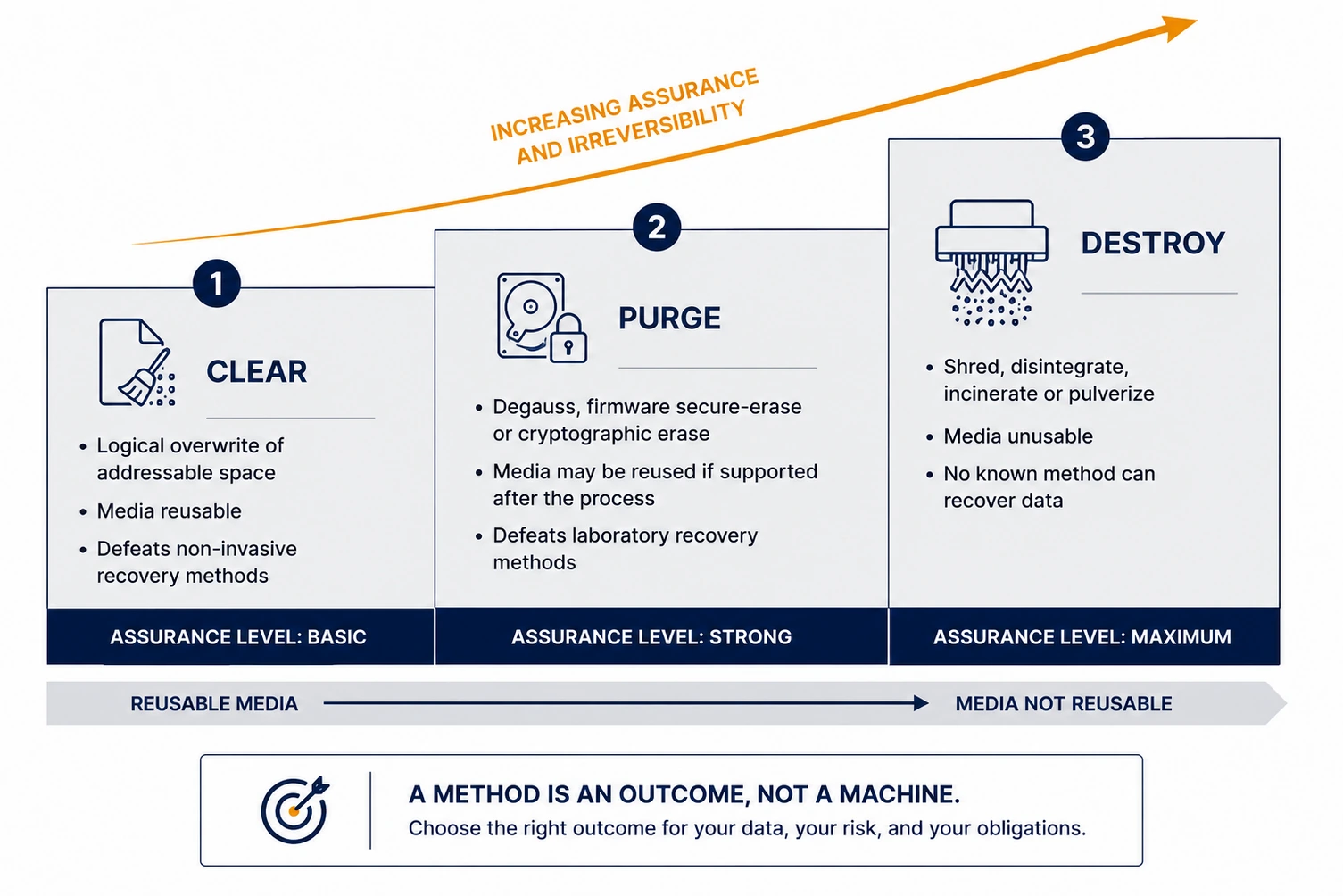
The authoritative reference for the field is NIST Special Publication 800-88 Revision 2, the federal guideline for media sanitization. It frames every method as one of three outcomes, ranked by how hard recovery becomes afterward. The residual data that survives weak methods is called data remanence, and countering it is the entire purpose of a sanitization standard.
What are the three NIST 800-88 r2 sanitization levels?
Each level describes a different assurance that data cannot return. The table below summarizes how they differ.
| Level | What it does | Typical methods | Media reusable? |
|---|---|---|---|
| Clear | Overwrites user-addressable storage using standard read and write commands | Single or multi-pass overwrite of a magnetic hard drive | Yes |
| Purge | Renders recovery infeasible even in a laboratory | Degaussing magnetic media, cryptographic erase, firmware secure erase | Sometimes |
| Destroy | Physically ends the media’s ability to store data | Shredding, disintegration, incineration | No |
The NIST definition of Clear applies to reusable magnetic hard drives and does not reliably sanitize solid state or flash media, because wear leveling scatters data across cells the overwrite command never reaches. The NIST definition of Purge covers degaussing and cryptographic erase, which defeat laboratory recovery. Destroy is the endpoint for the most sensitive material and for any medium that cannot be verified another way.
How does data destruction work on different media?
Media type dictates method, because the same technique produces different results on different hardware. Degaussing erases a magnetic hard drive by collapsing its magnetic field, yet it has no effect on flash memory, which stores data as trapped electrical charge rather than magnetic orientation; flash instead requires shredding or a verified erase.
| Media | Recommended approach | Reason |
|---|---|---|
| Magnetic hard drive | Degauss then shred, or overwrite for reuse | Magnetic domains respond to a strong field |
| Solid state and flash | Shred, or cryptographic erase for reuse | Wear leveling defeats overwriting |
| Magnetic tape | Degauss above the rated coercivity, or shred | High coercivity requires a matched degausser |
| Optical disc | Destroy only | Data is burned into the disc surface |
Why does data destruction matter for compliance?
Several federal rules require covered organizations to render discarded data unreadable, and our HIPAA media disposal and NIST 800-88 guides map them to methods. The Health Insurance Portability and Accountability Act obligates covered entities to dispose of protected health information so it cannot be reconstructed, guidance the Department of Health and Human Services details in its HIPAA disposal FAQ. The Fair and Accurate Credit Transactions Act sets a parallel duty for consumer report data through the FTC Disposal Rule. The obligation is not satisfied by the act of destruction alone; it is proven by a documented method and a serialized record an auditor can inspect.
When should each method apply?
The practical judgment is matching assurance to risk without overspending. For a reusable magnetic drive holding low-sensitivity data, Clear-level overwriting is proportionate and keeps the asset in service. For regulated data, or any device that cannot be verified after the fact, Destroy is the defensible choice because it removes the question of residual data entirely. Flash media forces the issue earlier: because host overwrites cannot reach every cell, the reliable options narrow to cryptographic erase on an encrypted-from-first-write drive or physical destruction. When in doubt, the level that leaves no recovery path is the one that survives an audit.
Key points
- Data destruction permanently removes data so it cannot be reconstructed, unlike deletion or formatting.
- NIST 800-88 r2 defines three levels, Clear, Purge, and Destroy, ranked by how hard recovery becomes.
- Method must match media: degaussing works on magnetic media only and has no effect on flash.
- Compliance is proven by a documented method and a serialized record, not by the act of destruction alone.
Data Destruction Inc. matches the sanitization level to your media and data sensitivity, then documents the result: media is handled under tamper-evident chain of custody by trained, bonded, background-checked operators, and every project closes with a serialized Certificate of Destruction, provided within 24 hours after the destruction event is complete. To scope a compliant project for retired equipment, call (866) 850-7977.
FAQ
Is deleting a file the same as data destruction?
No. Deleting a file removes the pointer that lets the system find it, but the underlying data stays on the media until it is overwritten. Recovery software can reconstruct deleted files until that space is reused.
Does formatting a drive destroy the data?
No. A quick format rebuilds the file index and a full format may check the surface, but neither reliably removes the underlying data. Formatted drives routinely yield recoverable data under forensic tools.
Which sanitization level do I need?
Match the level to media and sensitivity. Clear suits reusable magnetic drives with low-sensitivity data, Purge covers degaussing and cryptographic erase, and Destroy is the defensible choice for regulated data or any medium you cannot verify.
Can data be recovered after physical destruction?
Properly executed physical destruction reduces media to fragments below the size at which data can be read, which places it in the Destroy category and ends recovery.
Does degaussing work on an SSD?
No. Degaussing collapses a magnetic field, and solid state drives store data as trapped electrical charge, not magnetically. Degaussing an SSD does nothing; those devices require cryptographic erase or physical destruction.
How do I prove the data was destroyed?
Retain a serialized Certificate of Destruction tied to the specific media, supported by a documented chain of custody. That record is what demonstrates compliance during an audit.
—