
What data remanence actually is
When an operating system deletes a file, it removes the pointer that lets you find the file, then marks the space as available. The underlying bits stay on the medium until something physically overwrites or erases them. That leftover data is remanence. It is why recovery software can undelete files, why a formatted drive still yields data, and why a discarded drive is a breach waiting to happen. Sanitization is the deliberate act of reducing remanence to the point where recovery is infeasible at a defined level of effort.
Where remanence hides, medium by medium
Remanence is not one phenomenon. Each medium retains data through a different mechanism, and that is why no single method fits everything.
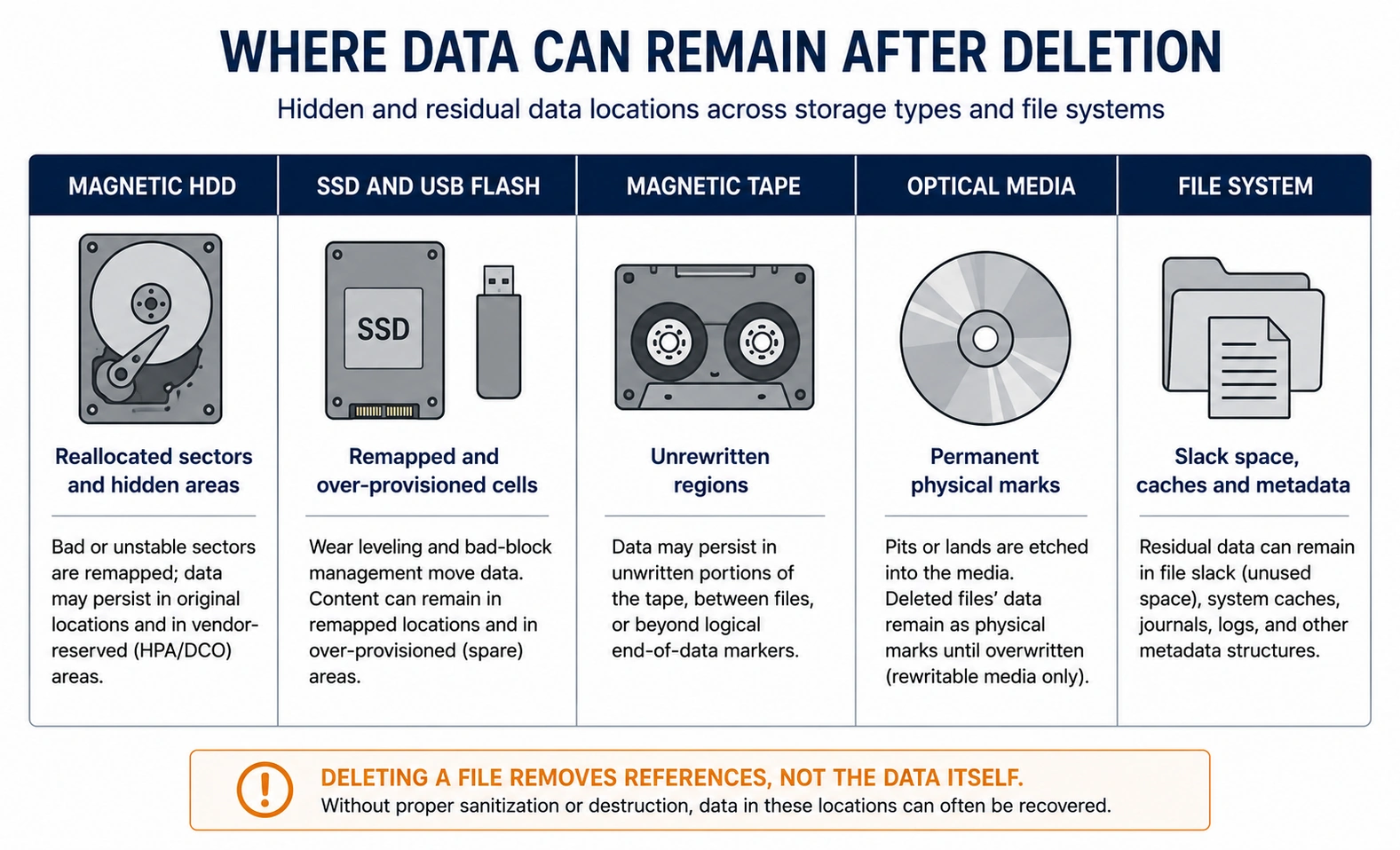
- Magnetic hard drives hold data as magnetic orientation on the platters. Beyond deleted files, remanence hides in reallocated sectors the drive retired after errors and in host-protected or device-configuration areas that a naive overwrite skips.
- Solid-state and USB flash store charge in NAND cells, and the flash translation layer scatters copies across remapped pages, over-provisioned capacity, and retired blocks that no host command reaches.
- Magnetic tape retains data along the full length of the ribbon, including regions an append-based backup never rewrote.
- Optical media holds data as permanent physical marks, so on write-once discs the remanence is the data, unerasable by design.
- Every file system adds its own residue: slack space at the end of allocated clusters, temporary and cached copies, journal and snapshot data, and metadata that can reveal file names and structure long after the content seems gone.
Why deleting and formatting leave remanence intact
Deleting changes bookkeeping, not bits. A quick format rewrites the file system’s table of contents and leaves the data blocks untouched, which is why formatting does not erase data. Even a full format may only verify sectors rather than sanitize them. None of these operations is designed to reduce remanence to a defined assurance level, which is exactly why they fail as sanitization and why breach investigations so often trace back to a drive someone believed was empty.
How NIST 800-88 addresses remanence
The standard, set out in the federal Guidelines for Media Sanitization, frames sanitization as three escalating levels of assurance against recovery. Clear uses standard read and write commands to overwrite user-addressable space, the basis of hard drive data wiping, which defeats casual recovery but not remanence hidden in reallocated or over-provisioned areas. Purge applies media-specific methods, degaussing for magnetic media, firmware sanitize or cryptographic erase for flash, that reach the hidden regions and resist laboratory recovery. Destroy, delivered as certified hard drive destruction, physically renders the medium and its remanence unrecoverable. The standard also stresses verification, because a method you cannot confirm worked is not a control you can defend. Choosing the level is a judgment about data sensitivity, whether the medium stays in your control, and what evidence you must produce.
Key points
- Data remanence is the residual data that persists after deletion or formatting.
- Deleting removes pointers and formatting rewrites an index; neither reduces remanence.
- Each medium retains remanence differently, so sanitization methods are media-specific.
- NIST 800-88 defines Clear, Purge, and Destroy as escalating levels of assurance against recovery.
- Verification matters, because an unconfirmed sanitization is not a defensible control.
Data Destruction Inc. treats remanence as the thing being controlled, not the file that appears to be gone. We select Clear, Purge, or Destroy based on the medium, the sensitivity of the data, and whether it is leaving your custody, and we verify and document the result. Custody is tracked under tamper-evident seal by trained, bonded, background-checked operators, and you receive a serialized Certificate of Destruction provided within 24 hours after the destruction event is complete. To match a method to your media, call (866) 850-7977.
FAQ
What is data remanence in simple terms?
It is the data that remains on a storage medium after you delete or format it. The pointers are gone, but the underlying bits stay until something physically overwrites or erases them, which is why deleted files can be recovered.
Why does deleting a file not remove the data?
Deleting only removes the reference that lets the system find the file and marks the space reusable. The actual contents stay in place until they are overwritten, so recovery tools can reconstruct them.
Does formatting a drive remove remanence?
No. A quick format rewrites the file system index and leaves the data intact, and even a full format may only check sectors rather than sanitize them. Neither is designed to reduce remanence to a defined assurance level.
Can data be recovered after a single overwrite?
On a modern hard drive a single full-span overwrite defeats normal recovery, but remanence can persist in reallocated sectors or host-protected areas that the overwrite skipped. On flash, a host overwrite may miss hidden cells entirely, so a firmware Purge or destruction is needed.
How does NIST 800-88 handle remanence?
It defines three escalating levels of assurance against recovery: Clear overwrites addressable space, Purge applies media-specific methods that reach hidden regions, and Destroy renders the medium unrecoverable. It also requires verification of the result.
—