
What formatting changes and what it leaves
A file system keeps two things: the data itself and an index that maps file names to the physical locations of that data. Formatting rewrites the index and marks the space as available, but it does not touch the data blocks the index used to point to. To the operating system the drive now appears blank, because it no longer has a map to the old files. The files are still physically present, unmapped rather than erased.
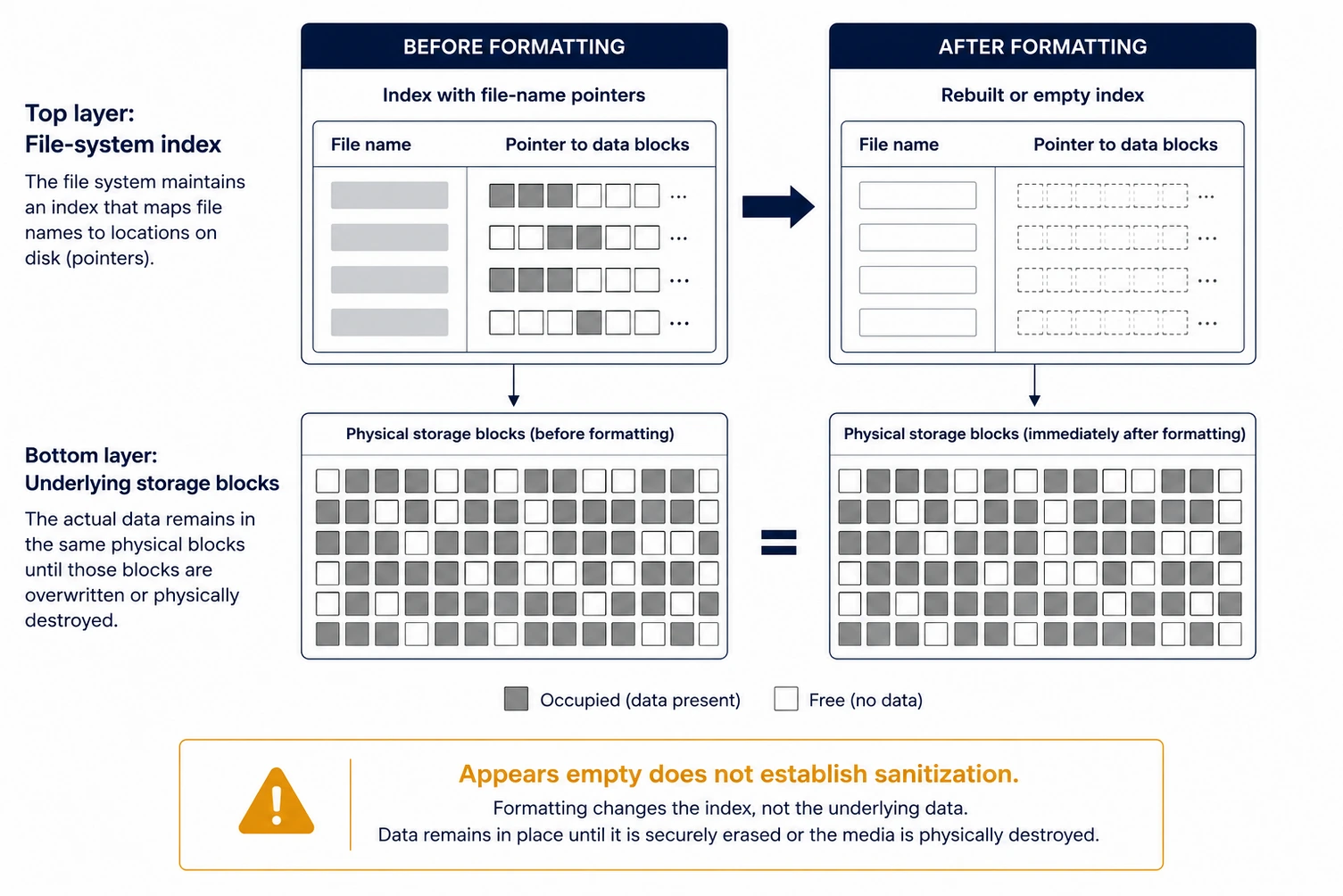
The intuition that empty equals gone is what makes this dangerous. The drive reports zero used space while holding gigabytes of recoverable content.
Quick format versus full format
The two format options differ, but neither is destruction.
- A quick format only rebuilds the file system index. The data blocks are untouched and fully recoverable.
- A full format additionally checks the drive for bad sectors and, on modern Windows, writes zeros across the volume. A full-coverage zero write on a magnetic hard drive approaches a NIST Clear, but behavior varies by operating system and version, and it is not designed or verified as a sanitization method.
Because the outcome depends on the tool, the version, and the media, relying on a format to sanitize is guessing rather than knowing.
Why the data persists
Storage is designed so that writing data and erasing data are different operations, and normal use almost never erases. Deleting and formatting both change bookkeeping, not content, because overwriting every block on every retirement would be slow and would wear the media unnecessarily. The system’s efficiency is exactly what leaves recoverable data behind: it does the least work needed to make space appear free, which is to update the map, not to scrub the blocks.
SSDs: TRIM complicates but does not guarantee
On SSDs the picture shifts because of a command called TRIM, which tells the drive which blocks are no longer in use so its controller can erase them in the background for performance. TRIM can cause formatted data to become unrecoverable over time, but it is not a sanitization guarantee: it is best-effort and timing-dependent, it may be disabled or unsupported in some configurations, and it does not reach data in over-provisioned or remapped cells. Counting on TRIM to sanitize an SSD is unsafe; flash needs a firmware sanitize command, cryptographic erase, or destruction.
What actually removes the data
Removing data reliably requires a method that acts on the data itself, not the index. On a magnetic hard drive that means a verified full overwrite (NIST Clear), degaussing (Purge), or shredding (Destroy). On flash it means a firmware sanitize, cryptographic erase where the drive was encrypted from first write (Purge), or destruction. The common thread is that each addresses the recording medium directly, which formatting never does. This content is informational and not legal advice; confirm your obligations with counsel.
Key points
- Formatting rebuilds the file system index and leaves the underlying data recoverable.
- A quick format touches only the index; a full format may zero a magnetic volume but is not a verified sanitization method.
- Storage updates bookkeeping rather than scrubbing blocks, which is why data persists after a format.
- On SSDs, TRIM may remove data over time but is not a guarantee and misses over-provisioned cells.
- Reliable removal requires overwrite, degauss, firmware sanitize, cryptographic erase, or destruction.
Data Destruction Inc. replaces the guesswork of formatting with a verifiable outcome: overwrite for magnetic drives you will reuse, firmware or cryptographic purge for flash, and degaussing or shredding where destruction is required, each recorded with a serialized Certificate of Destruction, provided within 24 hours after the destruction event is complete, under chain of custody handled by trained, bonded, background-checked operators. To retire drives without relying on a format, call (866) 850-7977.
Related services: hard drive data wiping for verified overwrite and hard drive shredding for destruction. Related reading: what is data destruction and wipe vs erase vs delete vs destroy. The sanitization categories are defined in our NIST SP 800-88 overview.
Authoritative standards: NIST SP 800-88 Rev. 2, Guidelines for Media Sanitization, and the NIST definition of Clear.
FAQ
Does formatting a drive delete the files on it?
No. Formatting rebuilds the file system index so the drive looks empty, but the file contents stay on the media until they are overwritten. Recovery tools can read formatted files back, which is why formatting is not a sanitization method.
Is a full format more secure than a quick format?
Somewhat, but neither is destruction. A quick format only rewrites the index, while a full format may write zeros across a magnetic volume, which approaches a NIST Clear. Behavior varies by operating system and version, so a format is not a verified sanitization method.
Can data be recovered after I format a drive?
Yes, especially after a quick format, where the data blocks are untouched. Even after a full format, recovery may be possible depending on the tool and media, which is why sensitive drives need a verified overwrite, degauss, or destruction.
Does formatting an SSD erase it because of TRIM?
Not reliably. TRIM lets an SSD controller erase unused blocks in the background, which can make formatted data unrecoverable over time, but it is timing-dependent, may be disabled, and misses over-provisioned cells. An SSD needs a firmware sanitize, cryptographic erase, or destruction. See our SSD architecture explainer.
What should I do instead of formatting to make a drive safe?
Use a method that acts on the data: a verified full overwrite (Clear), degaussing (Purge), or shredding (Destroy) for magnetic drives, and firmware sanitize, cryptographic erase, or destruction for flash. Each of these is provable, unlike a format.
Is formatting ever enough for compliance?
No. Because a format leaves data recoverable and is not a recognized sanitization method, it does not satisfy rules like HIPAA media disposal or the GLBA Safeguards Rule, which expect a verified method and documented proof.
—